

Learn more about Rand SIM Labs: Where Engineering Curiosity Meets AI
What if your wildest engineering idea could actually be simulated in real time, using real simulation tools and the help of AI.
Not by submitting a support ticket. Not by waiting for a research paper. Not by hours and hours of work.
But simply by posing the idea and seeing what’s possible.
That's the idea behind Rand SIM Labs an open platform where engineering curiosity drives AI-powered simulations.
Rand SIM Labs is an interactive platform where anyone can submit a simulation idea, vote on ideas that are crowdsourced from the community, and watch those questions become engineering studies powered by AI using licensed Ansys software.
It's more than a collection of interesting simulations. It's an open look at how AI can automate engineering workflows while making every study transparent from start to finish.
Whether the topic is structural mechanics, fluid flow, optics, explicit dynamics, or something completely unexpected, every study begins with one simple question: "What if...?"
How It Works
The process is simple:
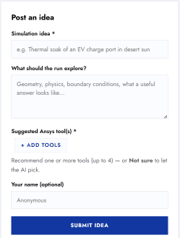
- Submit an idea. Have a simulation you've always wanted to see? Add it to the Ideas Board.
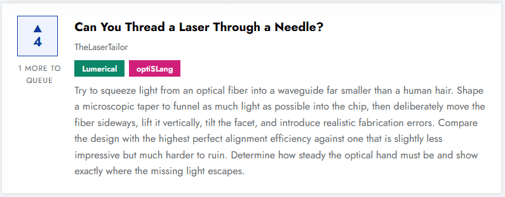
- Vote. Community votes determine what moves into the simulation queue. Five votes sends an idea into the AI queue.

- AI gets to work. Once selected, an AI-driven workflow helps build the geometry, generate the mesh, and prepare the simulation using licensed Ansys software.

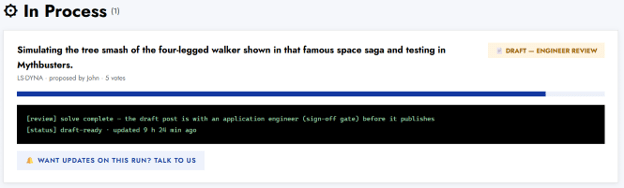
4. The study is published. Every study publishes with its assumptions, solve statistics, and limitations in the open so everyone can see exactly how the results were produced.
Why We Built It
AI has become one of the biggest conversations in engineering.
But most discussions stop at what AI might do someday.
We wanted to show what it can do today.
Rand SIM Labs demonstrates how AI can support simulation workflows by reducing manual effort while making the entire process open and transparent. Every study clearly shares its assumptions, solve statistics, simplifications, and limitations so readers can understand both the results and how they were achieved.
It's also an opportunity to share something we love: solving interesting engineering problems.
These studies are exploratory by design. They're intended to spark discussion, answer interesting questions, and demonstrate what's possible with AI-assisted simulation.
And if someone spots something they'd approach differently? That's part of the community experience. Submit an idea, vote on it, and let's run it again.
Explore More Than Just Results
Every completed study includes more than a simple answer.
Visitors can explore:
- Engineering summaries explaining the idea being posed
- Simulation animations that bring the physics to life
- Solver statistics and mesh information
- Assumptions, limitations, and engineering caveats
- The reasoning behind the conclusions
The goal isn't simply to say whether something works or doesn't, it’s to show how engineers arrive at those answers.
See AI in Action
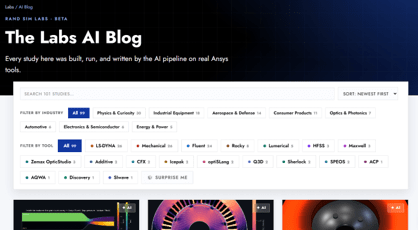
Today, Rand SIM Labs features a growing collection of studies spanning structures (FEA), fluids (CFD), explicit dynamics, optics, electromagnetics, and more. With new simulations being added daily as community ideas move through the pipeline.
Whether you're an experienced simulation engineer, a designer looking to learn more, a student fascinated by physics, or simply someone who enjoys asking "what if," there's something to discover.
Engineering starts with curiosity.
We're just giving curiosity a place to run.
Ready to explore?
Visit Rand SIM Labs to browse completed studies, submit your own ideas, vote on upcoming simulations, and see how AI and engineering are working together to answer questions worth asking.


